


- API Standards is a trusted framework that helps teams make consistent engineering decisions while reducing risk and operational uncertainty.
- Weak inspection and delayed maintenance can trigger shutdowns, safety incidents, and costly losses across operations.
- Applying API standards improves uptime, prioritizes high-risk assets, and cuts unnecessary maintenance work.
- Misinterpreting technical codes leads to poor decisions, higher costs, and missed early signs of equipment failure.
- Practical training bridges theory and field execution, helping engineers act confidently under real operational pressure.
API Standard remains one of the key pillars behind safe, efficient, and profitable operations in the oil and gas sector. When inspection programs break down, maintenance actions are postponed, or asset integrity is misunderstood, the impact can be significant—unexpected shutdowns, lost production, compliance issues, and expensive operational events.
For that reason, leading energy companies do not base critical decisions on assumptions. They depend on recognized engineering systems that help teams work with consistency, confidence, and stronger operational control.
API Standards are widely recognized as one of the most trusted frameworks across the global energy industry. For plant managers, engineering leaders, reliability teams, and executives, a strong understanding of these standards is no longer optional. It has become a strategic requirement for protecting critical assets, maintaining uptime, and driving stronger long-term business performance.
What Is API Standard in the Oil and Gas Industry?
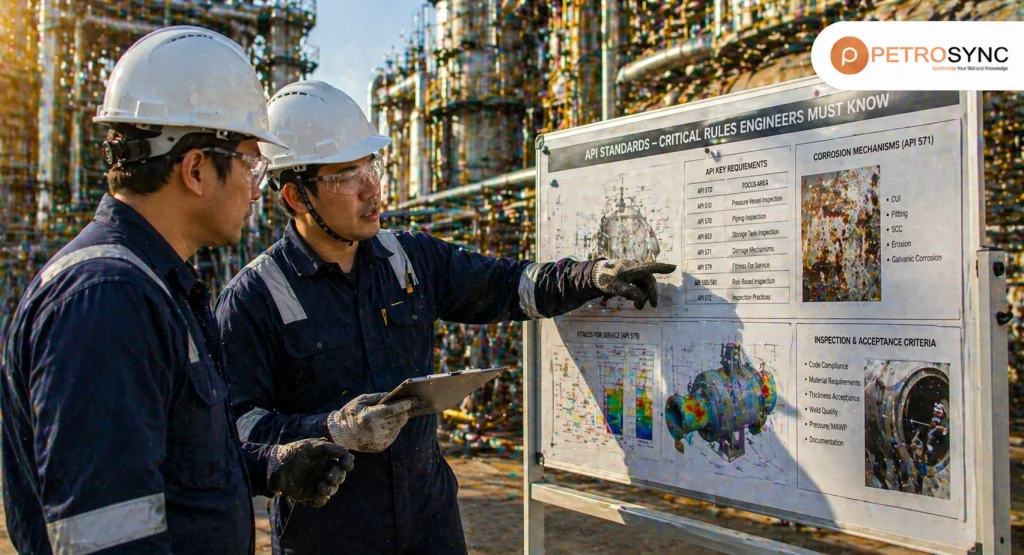
API Standards are internationally recognized technical guidelines developed for the petroleum, petrochemical, and wider energy industries. These standards help organizations design, inspect, operate, repair, and maintain essential equipment in a safe and efficient manner.
They are commonly applied in:
- Refineries
- LNG plants
- Offshore facilities
- Petrochemical complexes
- Storage terminals
- Pipeline systems
Well-known examples include:
- API 510 – Pressure Vessel Inspector
- API 570 – Piping Inspector
- API 653 – Tank Inspection, Repair, Alteration, and Reconstruction
- API 571 – Damage Mechanisms Affecting Fixed Equipment in the Refining Industry
- API 579 – Fitness For Service
- API 580 and 581 – Risk-Based Inspection & Base Resource Document
- API 936 – Refractory Material Design, Application, Installation and Inspection
Simply put, API Standards help companies make smarter engineering decisions while lowering uncertainty.
Why API Standards Are Non-Negotiable for Safety and Efficiency
1. Prevent Costly Equipment Failures and Accidents
Industrial assets naturally deteriorate as time passes. Corrosion, fatigue, cracking, erosion, and overheating can develop quietly long before visible signs appear.
Without proper management, a hidden issue may lead to:
- Leaks
- Fires
- Emergency shutdowns
- Major repair expenses
- Safety incidents
API Standards provide clear inspection approaches and repair requirements that allow teams to identify threats earlier and respond before failure happens.
2. Ensure Full Compliance with Industry Regulations
Regulators, investors, and stakeholders expect operators to follow accepted engineering practices. API Standards are widely recognized as reliable references for asset integrity and mechanical reliability.
Organizations that align with these frameworks often gain:
- Better audit preparedness
- Stronger documentation processes
- Lower compliance exposGreater stakeholder trust
For larger companies, this creates operational as well as reputational advantages.
3. Improve Operational Reliability and Performance
High-performing plants do not treat every asset the same way. They focus resources where risk is highest.
API Risk-Based Inspection methods help companies prioritize critical equipment first, improving maintenance efficiency while reducing unnecessary work.
The outcome often includes:
- Higher uptime
- Reduced maintenance waste
- More accurate planning
- Stable production performance
The Real Challenges of Implementing API Standards in the Field
1. Limited Practical Understanding Among Engineers
Many professionals recognize API standard names, yet face difficulties when applying them in live operating environments.
Reading API 570 is very different from reviewing active piping corrosion, turnaround timing, urgent repairs, and production pressure simultaneously.
This gap between theory and field execution often leads to inconsistent decisions.
2. Difficulty Interpreting Complex API Codes
API documents are technical by nature. They contain formulas, definitions, scope limitations, exceptions, and engineering judgment requirements.
Misreading one section can result in:
- Incorrect inspection intervals
- Delayed responses
- Excessive maintenance activity
- Missed degradation risks
- Higher operating costs
3. Inconsistent Application Across Teams and Projects
Many organizations experience differences in how standards are applied across plants, departments, or contractors.
One facility may apply standards cautiously. Another may act only after failure occurs. A third may overspend on maintenance.
Without consistent alignment, performance becomes uneven and risk increases.
Are You Fully Equipped to Apply API Standards in Real Work?
1. Understanding Technical Codes Alone Is Not Enough
Knowing what a standard says does not automatically prepare someone for operational decisions.
Leaders are frequently asked:
- Can this vessel continue operating safely?
- Should this line be repaired now or during shutdown?
- Is the corrosion rate still acceptable?
- Does this asset need a Fitness-For-Service review?
These decisions require sound judgment supported by practical experience.
2. Real-World Application Requires Practical Experience
Operational choices often happen under pressure:
- Production targets remain active
- Downtime costs are high
- Shutdown windows are limited
- Data may be incomplete
That is where practical capability becomes critical.
3. Mistakes Can Lead to Serious Safety Risks and Downtime
Small technical mistakes can quickly turn into large business losses.
Poor planning, inaccurate assessments, or delayed repairs may cause:
- Lost production revenue
- Emergency maintenance spending
- Safety exposure
- Reputational damage
For management teams, technical capability is closely linked to business resilience.

How to Master API Standards and Apply Them with Confidence
1. Why API Standard Training Is Essential for Engineers
Structured training significantly shortens the learning curve.
Instead of learning through costly trial and error, professionals receive direct guidance from experienced instructors who understand real industrial environments.
For companies, this creates:
Faster skill development
Better engineering decisions
Lower operational risk
Stronger internal expertise
2. What You Will Learn to Apply API Standards Effectively
A quality training program typically includes:
Practical code interpretation
Inspection planning techniques
Damage mechanisms identification
Repair and rerating decisions
Risk-Based Inspection strategy
Fitness-For-Service fundamentals
Real industry case studies
This helps participants apply standards confidently in day-to-day work.
3. Why PetroSync Is Trusted by Industry Professionals
PetroSync is recognized for providing specialized technical training for professionals in oil and gas, petrochemical, and energy sectors.
Programs are built around practical implementation rather than theory alone.
As a result, participants gain knowledge they can use immediately to improve reliability, safety, and operational results.
Get Industry-Ready with API Standard Training at PetroSync
1. Strengthen Your Technical and Practical Expertise
PetroSync helps engineers close the gap between understanding standards and applying them effectively in the field.
Participants return with greater confidence in inspection planning, maintenance decisions, and integrity management.
2. Increase Your Value in High-Demand Projects
Companies actively seek professionals who understand:
Asset integrity
Reliability improvement
Compliance systems
Risk management
API competency strengthens credibility and career value.
3. Learn from Experts with Real Industry Experience
The most effective training comes from instructors who have handled real shutdowns, corrosion challenges, inspection programs, and plant performance issues.
That practical perspective accelerates learning far beyond theory alone.
Start Your API Standard Training with PetroSync Today
In today’s competitive energy market, technical excellence creates measurable business value. Companies that invest in stronger engineering capability often reduce risk, improve uptime, and make better commercial decisions.
If your organization wants safer operations, stronger reliability, and more confident teams, now is the right time to strengthen API Standard capability.
PetroSync offers practical API Standard training designed for engineers, managers, and business leaders who need real results. Build a stronger workforce today and prepare your business for tomorrow’s operational challenges.
Frequently Asked Questions (FAQ)
API Standards are internationally recognized technical guidelines used to design, inspect, operate, repair, and maintain equipment safely and efficiently across oil, gas, and petrochemical industries.
API Standards help detect equipment issues early, prevent failures, ensure regulatory compliance, and improve reliability, which leads to safer operations and reduced downtime.
Common challenges include limited practical understanding, difficulty interpreting complex technical codes, and inconsistent application across teams or facilities.
Practical training helps engineers bridge the gap between theory and real-world application, enabling better decision-making under operational pressure and reducing costly mistakes.
Participants gain hands-on knowledge, improve inspection and maintenance decisions, enhance reliability and safety, and increase their value in high-demand engineering roles.

Results-oriented and thorough SEO specialist with extensive experience in conducting keyword research, developing and implementing digital website promotion strategies and plans, managing campaigns to develop company websites in the digital world, excellent knowledge of marketing techniques and principles, and attentive strong attention to detail.